

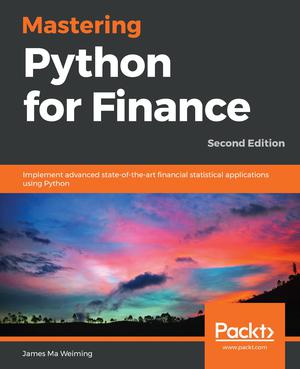
Treffer: Mastering Python for Finance Ed. 2
copyrighted
https://international.scholarvox.com/book/88869977
https://static2.cyberlibris.com/books_upload/136pix/9781789345278.jpg
1268869553
From OAIster®, provided by the OCLC Cooperative.
Weitere Informationen
Take your financial skills to the next level by mastering cutting-edge mathematical and statistical financial applications Key Features Explore advanced financial models used by the industry and ways of solving them using Python Build state-of-the-art infrastructure for modeling, visualization, trading, and more Empower your financial applications by applying machine learning and deep learning Book Description The second edition of Mastering Python for Finance will guide you through carrying out complex financial calculations practiced in the industry of finance by using next-generation methodologies. You will master the Python ecosystem by leveraging publicly available tools to successfully perform research studies and modeling, and learn to manage risks with the help of advanced examples. You will start by setting up your Jupyter notebook to implement the tasks throughout the book. You will learn to make efficient and powerful data-driven financial decisions using popular libraries such as TensorFlow, Keras, Numpy, SciPy, and sklearn. You will also learn how to build financial applications by mastering concepts such as stocks, options, interest rates and their derivatives, and risk analytics using computational methods. With these foundations, you will learn to apply statistical analysis to time series data, and understand how time series data is useful for implementing an event-driven backtesting system and for working with high-frequency data in building an algorithmic trading platform. Finally, you will explore machine learning and deep learning techniques that are applied in finance. By the end of this book, you will be able to apply Python to different paradigms in the financial industry and perform efficient data analysis. What you will learn Solve linear and nonlinear models representing various financial problems Perform principal component analysis on the DOW index and its components Analyze, predict, and forecast stationary and non-stationary time series